

Street Food Home
- Introduction
- Louisville, KY
- Cedar Rapids
- Chicago
- Denmark
- Plano/Dallas/Fort Worth
- Richmond, VA
- Singapore
- Trenton, NJ
- San Antonio, TX
- India
- New York City
- Nashville, TN
- Olympia, WA
Singapore
Rules for Hawker Centres
The Granny Table
| The rules of the hawker centre are not posted, but by gosh you'd better know them if you want to get along with the people around you. Let's start with the granny table. | 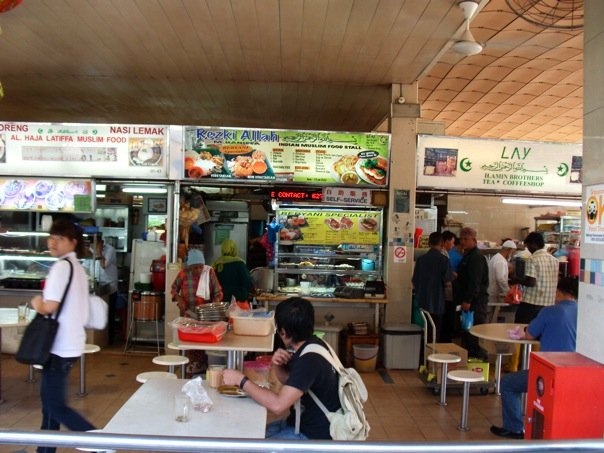 |
| The table right in front of a stall is where the family's grandmother sits and chops veg. This is her work space. Note the tubs of veg awaiting prep in the photo. It is not a public seating area. It will be cleared off and the public will be allowed to use it at the rush times, but in between, granny needs a place to sit and do her work, and you can go eat somewhere else. You have not been given the stinkeye until you walk toward granny's table with a tray in your hands, looking like you might be about to sit down. A glance up and away, a nod as if spotting someone, and a graceful change of course to a distant table is in order. |
Having Here or Taking With
You do not get a go order or a takeaway at a hawker centre. You have two options, Having Here, and Taking With. Get the phrasing right, it'll save time and you'll look a little bit less like a lost American. I got mistaken for being German, and did not correct the misapprehension. Hopefully I comported myself well and did not reflect badly on Germany that day. Having Here gets you your hot drink in a glass mug, and possibly the cold beverage as well, although canned soda is generally handed over unopened. The bottom of the mug has been painted. The person cleaning the dining area will pick up all the mugs, wash them, then sort them out to the stalls by color coding. Taking With gets you a beverage in a plastic drawstring bag with a straw thrown in, handed to you by the strings. Carrying a bag of hot tea tarik and sipping it through a straw was a novel experience, and a bit tricky. I learned to wait until I got to the office for a tea tarik from the machine. It wasn't as good as the stall, which used brewed tea and not a concentrate, but it was dispensed into a mug.
Having Here could be a bit of an adventure. The presentation depended on the stall you were at. My favorite at Seah Im, the hawker centre across the street from Harbourfront Centre, was an Indian place that did a dal and three for three dollars. They laid a banana leaf on the tray, tossed on a scoop of rice, poured the dal over the rice, spooned on three side dishes, and stuck a papad in the dal. What you got was Indian, vegetarian, and good, but depended on what they felt like making that day. I was there three times a week for six weeks and never figured out if there was a schedule. It may have depended on what looked good at the veg stalls. I'm going to have to talk about the wet market at Tekka Centre, and the veg seller on the next block, at some point. First day, I spotted the place, and was like, veg thali? I am so in. Went and found the two Americans I'd been put with for, I dunno, an attempt to pair me with someone from my own culture to ease the shock or something. They'd both brought their lunch. They looked at what I had, and shrugged, and said I looked like I knew what I was doing.
Pick a Long Line
Tekka Market has a massive hawker centre, that was very nearly overwhelming until I applied a rule. One of the problems of hawker centres is that they offer so many choices, I frequently got overloaded and had trouble making a decision, until I realized there was a rule I could apply. Look for the stalls with the longest lines. Get in one of them. Glance up and make sure they have something you can eat – I can't have beef or pork. If not, move to the next long line. Don't worry about the length, it'll move fast. Tekka Market, I glanced round, and got in the nearest long line, then took a few minutes to survey the long double row of stalls. The stall I'd picked had a few young men working hard, one collecting money, another handing bowls to the guy at the tub, who dished up chicken biryani from what looked less like a kettle and more like the tub out of a washing machine. He had a wooden paddle, filled each bowl with one scoop and handed it off to a guy who handed it to the customer. They had two more guys standing by with three full tubs of biryani and one empty, ready to haul the next tub into place when the current one was empty. I have eaten biryani in Noida, in Bengaluru, and in Mysore. I have had biryani in Nashville made by a retired Michelin-listed chef who had come from Mumbai to help his relatives with their restaurant. The washtub biryani was some damn fine food. Not overly spiced, the chicken had been slow simmered and fell apart when poked, and the rice was perfectly done. There was a basket to drop your bowl in, and yet another guy who was off at the edge of the hawker centre, by the hand wash bucket, cleaning the bowls at a spigot.
Hand Washing
We need to talk about hand washing, and about eating with your hand. Not your hands. Use your right hand for eating, and keep your left hand clean. That way, when you go to the bucket at the edge of the dining area, you have a hand to pick up the lade with that's not messy. Scoop a lade out of the bucket, and pour it over your hand to rinse, over the splash area by the drain, it'll be obvious. Do not under any circumstances put your messy hand in the bucket. Rinse again if you need to, then you can swap hands and rinse the left if you feel the need. If in doubt, watch what other people are doing while you're eating. Note how they approach the hand washing station, and how they manage it. As with any travel, follow the lead of the locals, they know what they're doing, they live there. Dining halls and other indoor facilities will normally have what looks to Americans like a row of water fountains. These are hand washing stations. Observe, and see how they're used before you go up there yourself.
Prayer Spots
Speaking of observation, take note of the prayer spots. The staff will have a couple of places, usually by the support columns and out of the way of the foot traffic to begin with, where the Muslim employees will go for prayers. When it gets to be that time of day, don't block the faithful from putting down their mats. One of the big rules of Singapore is, you do your thing, and I will do mine, and we will be polite to each other when we meet. This is how a Buddhist temple, a Christian church, and a masjid manage to peacefully coexist on the same street.
Respect Over Money
There's two different gestures you'll see to show respect to the other person in the transaction when handling money. One is a sweep of the off hand under the presenting forearm, as if pushing back a long sleeve. I generally saw that one in presentation of the bill or receipt, or return of the card, with shop clerks. More common is simply using both hands when presenting a credit or debit card, a bill, or a receipt, by either the customer or the vendor. Use both hands to receive the item in either situation. This is the same both-hands gesture of respect, minus the bow over the card, used when someone you want to show respect to offers their business card. I still find myself automatically responding with both hands any time the vendor uses either gesture, which amused some folks I hung out with in NYC's Chinatown.